Skip to content
What This Guide Covers
A diesel engine that is maintained properly can last 500,000 miles or more. One that is neglected will cost you far more in repairs and in lost business than any maintenance schedule ever would. This complete guide covers everything fleet owners and diesel truck operators need to know: from oil change intervals and fuel filter care to turbocharger maintenance, engine service schedules, and the warning signs that mean your truck needs attention right now.
Introduction: Why Diesel Engine Maintenance Is Different
Diesel engines are built to work hard. They produce more torque, run at higher compression ratios, and typically outlast gasoline engines by a significant margin but only when they are properly maintained. The moment you start cutting corners on a diesel service schedule, the clock starts ticking on expensive repairs.
For fleet owners on New York City whether you run delivery vans out of Freeport, construction trucks in Nassau County, or a mixed commercial fleet across the Island diesel engine maintenance is not just a mechanical concern. It is a business decision. Every truck that breaks down costs you money twice: once for the repair, and once for the revenue you lose while it sits in a shop.
This guide is written for real fleet operators who want straightforward, practical guidance not a textbook. Whether you manage two trucks or twenty, the fundamentals of keeping a diesel engine healthy come down to the same set of habits. Let’s go through all of them.
Why Regular Maintenance Matters for Fleet Owners
The average diesel engine in a commercial truck represents a $15,000–$40,000 investment. Proper maintenance is what protects that investment and keeps it generating revenue instead of sitting in a repair bay.
Here is the case in plain numbers:
| With a Maintenance Schedule | Without a Maintenance Schedule |
| Planned oil change: $120–$250 | Emergency engine repair from sludge: $2,500–$8,000 |
| Fuel filter replacement: $80–$180 | Injector failure from contaminated fuel: $1,200–$3,500 |
| DPF cleaning service: $350–$600 | DPF replacement: $3,000–$6,000 |
| Annual turbo inspection: $150–$300 | Turbocharger replacement: $1,800–$4,500 |
| Coolant flush: $150–$250 | Overheated engine repair: $3,000–$12,000+ |
Beyond the cost comparison, planned maintenance also means you control when the truck is in the shop not your engine. A preventive service appointment takes a few hours. An emergency repair can take days and strand a driver mid-route.
The Fleet Owner’s Real Advantage:
Businesses that run structured diesel maintenance programs typically see 30–50% lower annual repair costs than those operating on a reactive basis. The math is not complicated small, scheduled expenses consistently beat large, unplanned ones.
Common Diesel Engine Problems Caused by Poor Maintenance
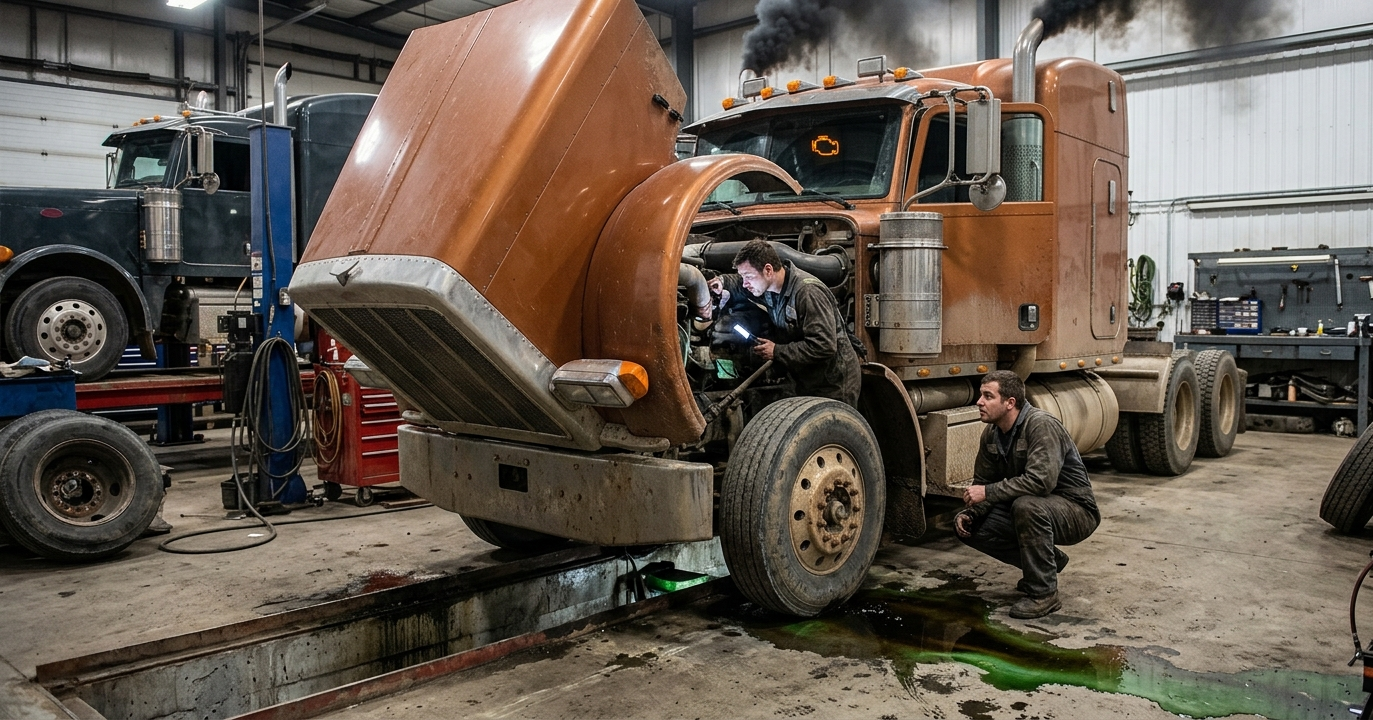
Most major diesel engine failures do not come out of nowhere. They are the result of deferred maintenance small problems that were ignored until they became expensive ones. These are the most common issues we see at our diesel mechanic shop when fleet owners have let their service schedule slip:
Engine Oil Sludge and Bearing Wear
Old, degraded engine oil stops lubricating properly and begins to form sludge a thick, sticky residue that coats internal engine components. Once sludge builds up in oil passages and around bearings, you are heading toward premature wear, overheating, and eventually engine seizure. On a diesel truck running daily routes, oil degradation happens faster than most people expect.
Clogged Fuel Injectors
Diesel fuel injectors spray fuel into the combustion chamber at extremely high pressure often 20,000–30,000 PSI on modern common-rail systems. Over time, contaminated fuel, degraded diesel, and lack of filter maintenance causes deposits to build up on injector tips. The result is poor atomization, rough running, loss of power, excessive black smoke, and dramatically worse fuel economy. Injector replacement is not cheap.
DPF (Diesel Particulate Filter) Failure
The DPF captures soot from the exhaust stream and burns it off periodically through a process called regeneration. When a truck runs too many short routes common for delivery fleets on Long Island the DPF never gets hot enough to regenerate properly. Soot builds up until the filter is blocked, triggering a fault code, a derate, or a complete shutdown. A cleaning or replacement that could have been avoided with proper regeneration management becomes a four-figure bill.
Turbocharger Failure
Turbochargers on diesel trucks spin at up to 200,000 RPM and are lubricated entirely by engine oil. When oil changes are deferred and oil quality degrades, that oil can no longer protect the turbo’s bearings adequately. The result is shaft play, oil leaking into the intake or exhaust, and eventually total turbocharger failure. The fix costs significantly more than the oil change that would have prevented it.
Cooling System Failure and Overheating
Diesel engines generate enormous amounts of heat. The cooling system coolant, hoses, water pump, thermostat, and radiator is responsible for keeping that heat under control. Neglecting coolant flushes allows the coolant to degrade, become acidic, and start corroding the cooling system from the inside. A blown head gasket or warped cylinder head from chronic overheating is one of the most expensive diesel repairs that exists.
Essential Diesel Maintenance Tips
These are the diesel maintenance tips that experienced fleet operators and certified diesel mechanics agree on. Follow them consistently and your engines will reward you with longer service life and fewer surprises.
Change the Engine Oil on Schedule — Without Exception
Engine oil is the lifeblood of a diesel engine. Most modern diesel trucks require an oil change every 10,000–15,000 miles under normal operating conditions, though high-load or stop-and-go applications like delivery routes may call for a tighter interval of 7,500–10,000 miles. Always use the oil viscosity and specification required by your engine manufacturer not what is cheapest at the parts counter.
- Use the right oil spec: CK-4 or FA-4 rated oil for post-2017 diesel engines. Check your manufacturer’s spec sheet.
- Change the filter every time: A new filter with old oil, or old filter with new oil, defeats the purpose of the service.
- Check oil level weekly: Diesel engines can consume small amounts of oil between changes especially older or high-mileage units. Low oil pressure is an engine killer.
Replace Fuel Filters Regularly
Diesel fuel quality varies more than most drivers realize. Water contamination, microbial growth, and particulates in the fuel system are real concerns especially if your trucks are fueling at multiple locations. A clogged or contaminated fuel filter restricts flow to the injectors and causes injector wear, poor combustion, and rough running.
- Primary fuel filter: Replace every 10,000–15,000 miles or annually, whichever comes first.
- Secondary (water separator) filter: Check monthly — drain any accumulated water. Replace every 20,000–30,000 miles.
- If you see black smoke or power loss: Check the fuel filter first it is often the quickest and cheapest diagnosis.
Maintain the Air Intake and Air Filter
Diesel engines are air-hungry machines. A clean, unrestricted air supply is essential for proper combustion and fuel efficiency. A clogged air filter forces the engine to work harder, increases fuel consumption, and can cause the turbocharger to work beyond its design limits accelerating wear on both the turbo and the engine.
- Inspect the air filter every 15,000–25,000 miles depending on operating environment. Dusty job sites and gravel roads demand more frequent checks.
- Check all intake hoses and clamps for cracks, leaks, or looseness a boost or intake leak is a common cause of power loss and black smoke on diesel trucks.
Care for the Turbocharger
Turbocharger care starts with engine oil quality. That is the single most important factor. Beyond that:
- Allow the engine to idle for 2–3 minutes after a hard run before shutdown this lets the turbo cool down while still receiving lubrication.
- Avoid hot shutdowns after sustained high load the bearing housing can heat-soak and cook the oil if the turbo is not allowed to cool.
- Inspect for oil leaks at the turbo seals during every oil service a light sheen of oil at the inlet or outlet is an early warning of seal wear.
Flush and Maintain the Cooling System
Coolant does not last forever. Over time it loses its buffering ability, becomes acidic, and begins to corrode cooling system components. A scheduled coolant flush typically every 2–3 years or 100,000–150,000 miles is one of the most cost-effective preventive services you can do for a diesel engine.
- Always use the correct coolant type — many modern diesel engines require OAT or NOAT formulas, not universal green coolant.
- Check coolant concentration seasonally especially important on Long Island where winter temperatures can drop hard and fast.
- Inspect hoses and clamps for swelling, cracking, or softness annually.
Diesel Engine Service Schedule for Fleet Trucks
This diesel engine service schedule is designed for commercial fleet trucks operating in typical Long Island conditions daily routes, mixed highway and stop-and-go, moderate to heavy loads. Adjust intervals down for particularly harsh operating environments.
| Service Task | Recommended Interval | Notes |
| Engine oil & filter change | Every 10,000–15,000 mi | 7,500 mi for stop-and-go/high-load applications |
| Fuel filter (primary) | Every 10,000–15,000 mi | More frequent if fuel quality is suspect |
| Fuel filter (water separator) | Every 20,000–30,000 mi | Check and drain monthly |
| Air filter inspection | Every 15,000–25,000 mi | More often in dusty environments |
| Air filter replacement | Every 25,000–50,000 mi | Replace sooner if restriction is detected |
| DPF inspection/cleaning | Every 100,000–150,000 mi | Sooner if regeneration faults appear |
| Coolant flush | Every 2–3 years / 100K mi | Test pH and concentration annually |
| Turbocharger inspection | Every 50,000–75,000 mi | Check for shaft play, seals, oil leaks |
| Serpentine/drive belt inspection | Every 50,000 mi | Replace at 75,000–100,000 mi |
| Transmission fluid service | Every 50,000–75,000 mi | Sooner for towing/high-load fleets |
| Diesel exhaust fluid (DEF) check | Every oil change | Refill as needed; do not let run dry |
| Full diagnostic scan (ECM) | Every 6 months | Catches fault codes before they become failures |
| Brake inspection | Every 25,000–30,000 mi | More often for Long Island stop-and-go routes |
Pro Tip from Dave’s Team:
The most useful thing any fleet manager can do is request a full ECM diagnostic scan every six months even if no warning lights are on. Modern diesel trucks store pending fault codes that have not yet triggered a dash light. Catching them early is always cheaper than waiting for the truck to tell you something is wrong by the side of the road.
Diesel Truck Care Checklist: What to Check and When
Good diesel truck care is built on consistent habits. Here is a practical checklist broken down by frequency something every driver and fleet manager can follow without needing a mechanical background.
Daily / Pre-Trip Checks (Driver Responsibility)
- Engine oil level — check dipstick when cold; add if below minimum mark
- Coolant level — check reservoir, not radiator cap, on a warm engine
- DEF level — diesel exhaust fluid; engine may derate if this runs empty
- Brake function — check pedal feel and air pressure gauge before any loaded run
- Dashboard warning lights — any active light should be reported immediately, not ignored
- Visual walk-around — look for fluid spots under the truck, check tires for pressure and damage
Weekly Checks (Driver or Fleet Manager)
- Tire pressure and condition — underinflated tires increase fuel consumption and wear
- Lights and signals — all required for DOT compliance and safety
- Water separator drain — drain any accumulated water from the fuel-water separator
- Battery terminals — check for corrosion, especially through the winter months in NY
Monthly Checks (Fleet Manager + Mechanic)
- Air filter inspection — hold it to light; replace if visibly clogged or damaged
- Hoses and belts — look for cracking, swelling, or fraying; feel for softness in coolant hoses
- Exhaust system — check for unusual smoke color or smell; inspect visible pipes for cracks
- Mileage log review — compare actual mileage to your service schedule; flag trucks approaching intervals
Signs Your Diesel Engine Needs Service Now
Even with a solid maintenance schedule, diesel engines will sometimes show signs that something needs attention between scheduled services. These are the warning signals that experienced diesel mechanics tell fleet owners to act on immediately never ignore them in the hope they go away on their own.
| Warning Sign | Urgency | Likely Cause |
| Check engine / MIL light on | 🔴 Act Today | ECM fault code — could be minor or serious; only a diagnostic scan tells you which |
| Black smoke from exhaust | 🟠 Same Day | Rich fuel mixture: dirty air filter, injector issue, or boost leak — also hurts fuel economy |
| White smoke after warmup | 🔴 Stop Driving | Coolant in combustion — head gasket or cracked head; this worsens rapidly |
| Blue/grey smoke | 🟠 Same Day | Oil burning — turbo seal, worn piston rings, or valve seals depending on when it appears |
| Loss of power under load | 🟠 Within 48 hrs | Fuel filter restriction, boost leak, or early injector wear — diagnose before it escalates |
| Hard starting in cold weather | 🟡 Schedule Soon | Glow plug failure, weak batteries, or fuel gel — very common on Long Island in winter |
| Unusual engine knock | 🔴 Stop Driving | Bearing wear, injector knock, or low oil pressure — driving worsens internal damage rapidly |
| Fuel economy dropping | 🟡 Schedule Soon | Injectors, air filter, or combustion efficiency declining — early action saves fuel costs |
| Coolant level dropping | 🔴 Act Today | Internal or external coolant leak — overheating risk is real if not addressed quickly |
Benefits of Working With a Certified Diesel Mechanic
There is a meaningful difference between a general auto mechanic who occasionally works on diesel trucks and a certified diesel mechanic who specializes in commercial engine repairs. For fleet owners, that difference matters in both the quality of the work and the total cost of ownership.
Here is what a diesel specialist brings to the table that a general shop cannot match:
- Accurate diagnostics the first time: Diesel ECM systems are complex. A specialist with commercial-grade diagnostic tools pulls the right fault codes, interprets them correctly, and fixes the actual cause — not a symptom. Misdiagnosis is expensive and common at general shops.
- Familiarity with your specific vehicles: A shop that services the same truck brands repeatedly builds pattern recognition. They know which failures are common on your model year, what usually causes them, and how to address them efficiently.
- The right tools for the job: Diesel injector testing, DPF cleaning equipment, turbocharger analysis, and high-pressure fuel system work all require specialized tools that most general shops do not own.
- Faster turnaround: When a mechanic knows diesel systems well, they do not spend billable hours researching what they do not know. Fleet operators get their trucks back faster.
- Preventive guidance specific to your fleet: A diesel specialist can review your mileage, routes, load patterns, and fuel sources and give you maintenance advice that is actually calibrated to your operation — not just a generic service interval sheet.
If you are looking for a diesel mechanic, the most important thing you can ask a shop is how much of their work is specifically on commercial diesel trucks. A shop that services mostly passenger cars and “also does diesel” is not the same as a shop where diesel fleet work is the core of the business.
Why Professional Diesel Maintenance Saves Money Long Term
The most common objection fleet managers have to structured maintenance programs is cost. “We can not afford to bring every truck in that often.” The better question is: can you afford not to?
Here is what professional diesel truck maintenance actually delivers in financial terms:
Extended Engine Life
A well-maintained diesel engine in a commercial truck can last 500,000–800,000 miles before requiring a major overhaul. An engine that is neglected typically needs significant work at 200,000–300,000 miles. The difference in asset lifespan alone justifies the maintenance investment many times over.
Lower Fuel Costs
A diesel engine that is running cleanly — with fresh oil, clean injectors, unrestricted airflow, and correct combustion timing — uses fuel efficiently. Deferred maintenance degrades combustion quality, and every percentage point of fuel efficiency lost translates directly into higher operating costs across an entire fleet.
Avoiding Breakdown Costs
A roadside breakdown costs far more than the repair itself. You have towing fees, driver downtime, potential load delays, rescheduling costs, and in some cases customer penalties. Emergency repairs also carry a premium — shops charge more for urgent work, and parts ordered rush cost more than parts on a planned order.
DOT Compliance and Insurance
Fleet vehicles in New York State must meet DOT compliance standards. A truck that has been on a documented maintenance schedule is far more likely to pass a roadside inspection and avoid out-of-service orders. Maintenance records also matter to commercial auto insurers — and they can affect your premium rates and claim outcomes.
The Simple Math:
If proper diesel engine maintenance costs you $2,000–$3,000 per truck per year and extends that engine’s usable life by 100,000–200,000 miles, you are protecting a
| Ready to Put Your Diesel Fleet on a Real Maintenance Schedule? Dave’s Fleet Repair Inc. has served Long Island fleet operators for over 20 years. We specialize in diesel engines, commercial truck maintenance, and everything in between. Based in Freeport, NY we know Long Island fleets, and we know diesel. 📞 Schedule Diesel Service: (516) 451-9587 |
Frequently Asked Questions: Diesel Engine Maintenance
How often should I change the oil in a diesel truck?Most commercial diesel trucks require an oil change every 10,000–15,000 miles under normal operating conditions. High-load or frequent stop-and-go applications common on commercial routes may call for changes at 7,500–10,000 miles. Always follow your engine manufacturer’s specification and use the correct oil grade.
What is the most common cause of diesel engine failure?The single most common cause of premature diesel engine failure is neglected oil changes leading to lubrication breakdown. After that, the next most frequent causes are fuel system contamination, cooling system neglect (overheating), and deferred DPF maintenance. All of these are preventable.
How do I find a good diesel mechanic on Long Island?Look for a shop that specializes specifically in commercial diesel vehicles — not a general repair shop that occasionally works on trucks. Ask how much of their work is diesel fleet, what diagnostic equipment they use, and whether they can provide references from other commercial fleet clients. Dave’s Fleet Repair in Freeport, NY serves Nassau County and all of Long Island with certified diesel specialists.
Can cold weather damage a diesel engine?Cold weather presents specific challenges for diesel engines: fuel can gel at low temperatures, glow plugs must be in good condition for reliable cold starts, batteries must be at full capacity, and coolant concentration must be correct to prevent freeze damage. Long Island winters are not Arctic but they are cold enough to cause all of these problems if your diesel truck care has been deferred through the fall.
How much does diesel engine maintenance cost for a fleet?Annual preventive maintenance costs for a commercial diesel truck typically range from $1,500–$3,500 per vehicle depending on mileage, vehicle type, and the comprehensiveness of the program. This compares favorably to the cost of a single emergency repair, which can range from $1,200 for a fuel system issue to $12,000+ for an engine overhaul.